















The Metropolitan Nashville Airport Authority (MNAA) today commemorated the 40th anniversary of John C. Tune Airport®, also known as JWN®, marking four decades of service, growth and economic impact since its opening on July 20, 1986. The milestone highlighted JWN’s evolution from a dedicated general aviation facility into a modern, resilient asset that plays a vital role in supporting Middle Tennessee’s business and aviation needs.
“For four decades, John C. Tune Airport has supported businesses, strengthened our regional economy and served as a trusted partner to the aviation community,” said Doug Kreulen, president and CEO of MNAA. “JWN has continually grown, adapted and rebuilt with remarkable resilience. We’re proud of its legacy and even more optimistic about the opportunities ahead as we continue investing in its future.”
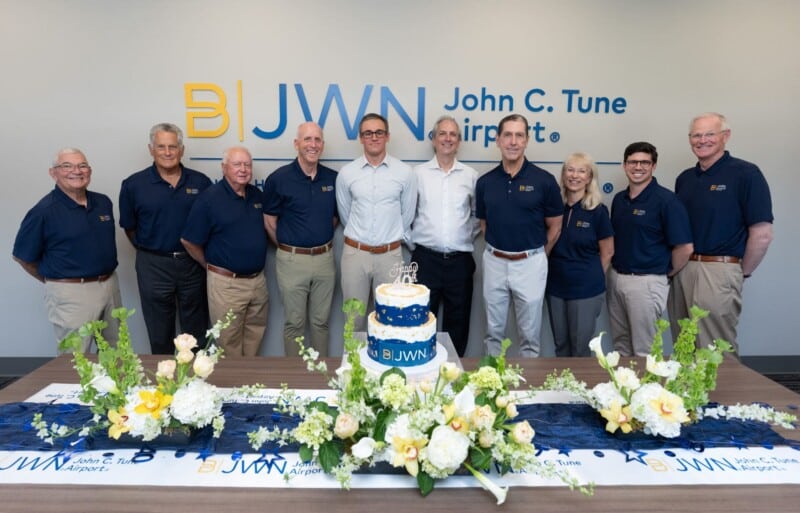
MNAA executives, staff and members of the MNAA Board of Commissioners gathered to celebrate the milestone and recognize JWN’s enduring impact on the region. David Tune, John C. Tune’s son, and John C. Tune II, his grandson, were both in attendance, honoring the legacy and namesake of the airport. The celebration highlighted JWN’s economic impact, underscoring the airport’s vital role in regional business activity, job creation and community connectivity.
A commemorative 40th birthday cake was presented and ceremonially cut by MNAA leadership and board members, marking the airport’s history and continued momentum.
JWN Historical Overview
In the late 1960s, Nashville civic leaders, led by pilot, attorney, businessman and aviation advocate John C. Tune, recognized the need for a dedicated facility to serve small general aviation aircraft. Their vision set the foundation for what would become John C. Tune Airport. MNAA launched a general aviation site study in 1972, and shortly after, the Federal Aviation Administration (FAA) approved a site in the Cockrill Bend area of West Nashville.
Construction began in 1983, and on July 20, 1986, John C. Tune Airport officially opened to the public. Built on roughly 300 acres, the airport debuted with a 5,000‑by‑100‑foot runway and a 10,000‑square‑foot conventional hangar, quickly establishing itself as an essential contributor to Middle Tennessee’s growing economy.
JWN’s commitment to safety and modernization earned national and state recognition, including the FAA Southern Region Airports Division’s 2015 General Aviation Airport Safety Award and an Honor Award from the American Council of Engineering Companies of Tennessee. In 2016, the Tennessee Department of Transportation’s Aeronautics Commission and the Tennessee Aviation Association named JWN Airport of the Year.
On March 3, 2020, an EF‑2 tornado caused catastrophic damage at JWN, destroying more than 90 aircraft and heavily damaging 17 hangars, with infrastructure losses estimated at $93 million. Despite the devastation, the airport restored full operations within 17 days, and MNAA quickly began planning a major redevelopment. That effort, known as Tune Taking Off, launched just months later, with a $38.8 million reconstruction breaking ground on July 20, 2021 — the airport’s 35th anniversary. That same year, JWN also opened a new 99‑foot air traffic control tower, designed to support long‑term operational needs.
JWN Today
Today, JWN stands as one of the region’s most important general aviation assets, a modern, resilient facility shaped by decades of expansion, innovation and community partnership. Looking ahead, Atlantic Aviation, a longstanding partner of MNAA has announced plans for a major new development that will further enhance services and support continued growth in general aviation. The project includes an executive fixed-base operator (FBO) terminal, a community hangar capable of accommodating the largest business aviation aircraft flying today, an attached office complex and a 70,000‑gallon fuel farm. The new facility is anticipated to be completed by the end of 2027.


Subscribe to our FREE Newsletter
















 today commemorated the 40th anniversary of John C. Tune Airport®, also known as JWN®, marking four decades of service, growth and economic impact since its opening on July 20, 1986)